
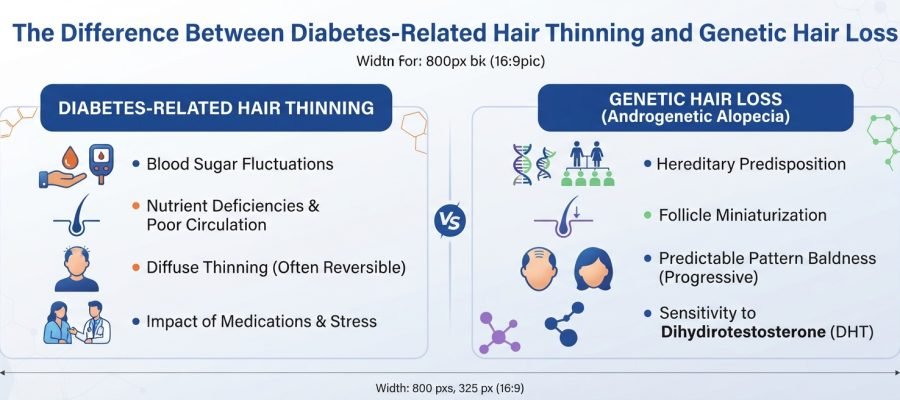

Finding more hair in your brush or shower drain can be unsettling, especially if you are already managing a health condition like diabetes. Is the thinning a side effect of blood sugar problems, or is it simply the hair loss that runs in your family? The two can look similar at first glance, yet they have different causes, follow different patterns, and call for different solutions.
In this guide, we break down the difference between diabetes-related hair thinning and genetic hair loss, how to tell them apart, and what you can do about each one, including when hair restoration may be worth considering.
How Normal Hair Growth Works
To understand why hair thins, it helps to know how it grows. Every hair follicle cycles through three main phases:
- Anagen (growth phase): Lasts two to seven years, and about 85 to 90 percent of your scalp hairs are here at any time.
- Catagen (transition phase): A short phase of a few weeks when growth stops.
- Telogen (resting phase): Lasts around three months, after which the hair sheds and a new one begins to grow.
Losing 50 to 100 hairs a day is normal. Hair loss becomes a concern when this cycle is disrupted, either because too many hairs shift into the resting phase early, or because follicles gradually shrink and stop producing thick, healthy strands. Diabetes tends to disrupt the cycle. Genetics tends to shrink the follicles. Understanding these two mechanisms also helps explain the causes of hair loss in women, who can experience diabetes-related shedding, genetic thinning, or both.
What Is Diabetes-Related Hair Thinning?
Hair loss is not a direct, universal symptom of diabetes, but it is more common in people whose condition is poorly controlled. Several mechanisms may be involved.
Poor circulation
High blood sugar over time can damage small blood vessels. Hair follicles depend on a steady supply of oxygen and nutrients, so reduced blood flow to the scalp can weaken them and slow growth.
Hormonal and metabolic stress
Diabetes places ongoing stress on the body. Physical stress, sudden illness, or rapid changes in blood sugar can push many follicles into the resting phase at once, a condition called telogen effluvium. Shedding usually appears a few months after the triggering event.
Thyroid and autoimmune conditions
People with diabetes, especially type 1, are more likely to have other autoimmune conditions. Thyroid disease and alopecia areata, an autoimmune condition that causes patchy hair loss, can both occur alongside diabetes.
Slower healing and scalp problems
Diabetes can slow wound healing and increase susceptibility to scalp infections, which may further affect hair health.
Medications and nutrition
Some medications and restrictive eating patterns can contribute to nutrient shortfalls, such as low iron, zinc, or biotin, which may also affect hair density.
What it typically looks like: Diabetes-related thinning is usually diffuse, meaning hair becomes thinner all over the scalp rather than in one specific area. You may also notice hair loss on the arms, legs, or eyebrows, and hair may regrow slowly after it falls out.
What Is Genetic Hair Loss?
Genetic hair loss, medically known as androgenetic alopecia, is the most common cause of hair loss worldwide. It is often called male pattern baldness or female pattern hair loss.
It is driven by inherited sensitivity of hair follicles to dihydrotestosterone (DHT), a hormone derived from testosterone. Over time, DHT causes susceptible follicles to shrink in a process called miniaturization. Hairs become shorter, finer, and lighter until the follicle eventually stops producing visible hair.
What it typically looks like:
- In men: A receding hairline at the temples, thinning at the crown, or both, which can progress to significant baldness.
- In women: Widening of the part and overall thinning on the top of the scalp, while the frontal hairline is usually preserved.
This type of loss is gradual, progressive, and often runs in families. It can begin as early as the late teens or twenties, though it more commonly becomes noticeable later in life.
Key Differences at a Glance
Feature | Diabetes-Related Thinning | Genetic Hair Loss |
Main cause | Poor circulation, metabolic stress, related conditions | Inherited follicle sensitivity to DHT |
Pattern | Diffuse thinning across the scalp | Receding hairline, crown thinning, or widening part |
Onset | Often tied to poor blood sugar control or a stressful event | Gradual, often starting in early adulthood |
Progression | May improve when the underlying issue is managed | Progressive without treatment |
Shedding | Noticeable increased shedding | Slow, subtle thinning with finer hairs |
Family history | Not necessarily | Usually present |
Reversibility | Often reversible if the cause is corrected | Can be slowed, rarely fully reversed |
Can You Have Both at the Same Time?
Yes. Genetic hair loss is extremely common, so a person with diabetes can easily have it as well. In that case, blood sugar problems may speed up or worsen thinning that was already beginning. This overlap is one reason self-diagnosis is difficult, and why a professional evaluation is worth the effort.
When to See a Doctor
Book an appointment with your primary care provider or a dermatologist if you notice:
- Sudden or rapid hair shedding
- Patchy bald spots
- Hair loss along with fatigue, weight changes, or frequent infections
- Scalp redness, itching, pain, or scaling
- Thinning that is clearly worsening over several months
A doctor may review your medical history, examine your scalp, and order tests such as blood glucose and HbA1c, a thyroid panel, and iron or vitamin D levels. A dermatologist may use a magnified scalp exam called trichoscopy, or occasionally a scalp biopsy, to confirm the type of hair loss.
If you have diabetes and notice unexplained hair loss, it is also a good moment to review your blood sugar management with your healthcare team.
Treatment Options for Each Type
Managing diabetes-related hair thinning
The goal is to correct the underlying problem:
- Improve blood sugar control through medication adherence, diet, exercise, and regular monitoring.
- Treat related conditions such as thyroid disorders.
- Address nutritional gaps under medical guidance. Do not start high-dose supplements without checking with your doctor, since too much of some nutrients can cause problems.
- Manage stress and sleep, both of which influence hair shedding.
- Be patient. Because of the hair growth cycle, regrowth can take several months after the cause is controlled.
Treating genetic hair loss
Genetic hair loss does not go away on its own, but it can often be slowed:
- Minoxidil is an over-the-counter topical treatment used by both men and women.
- Finasteride is a prescription oral medication for men that reduces DHT. It is not suitable for everyone, so talk with your doctor.
- Low-level laser therapy devices have some supporting evidence for modest improvement.
- Platelet-rich plasma (PRP) and other in-clinic treatments are sometimes used, though results vary.
- Hair transplant surgery is an option for suitable candidates with stable hair loss. People with diabetes should discuss healing risks with their surgeon beforehand.
Everyday Habits That Support Healthier Hair
Whatever the cause, a few habits can help create a better environment for hair growth:
- Eat a balanced diet with enough protein, iron, zinc, and healthy fats.
- Be gentle with your hair: limit tight hairstyles, harsh chemical treatments, and excessive heat.
- Keep your scalp clean and treat dandruff or irritation early.
- Stay physically active to support circulation.
- Avoid smoking, which harms blood vessels and may accelerate hair loss.
Frequently Asked Questions
Does diabetes cause hair loss?
Diabetes does not cause hair loss in everyone, but poorly controlled blood sugar, stress on the body, and associated conditions can contribute to thinning.
Is diabetic hair loss permanent?
Often it is not. When the underlying cause is addressed, many people see their hair regrow, though it can take several months.
How do I know if my hair loss is genetic?
A family history of hair loss and a classic pattern, such as a receding hairline, crown thinning, or a widening part, point toward genetic hair loss. A dermatologist can confirm the diagnosis.
Can lowering blood sugar regrow hair?
If poor blood sugar control or related stress is driving the shedding, better management can help hair recover. It will not reverse genetic hair loss.
The Bottom Line
Diabetes-related hair thinning and genetic hair loss may both leave you with less hair than you would like, but they are different conditions. Diabetes-related thinning tends to be diffuse and may improve once blood sugar and related health issues are under control. Genetic hair loss follows a predictable pattern, is driven by inherited sensitivity to DHT, and typically needs ongoing treatment to slow it.
If you are unsure which one you are dealing with, or you suspect both, a healthcare professional can help you find the right answer and the right plan. The sooner you act, the more hair you are likely to keep.
Please review our business on Google Yelp Facebook
Please visit our Members’ Area to access 100s of health and fitness topics and Join Our Community to access shared knowledge, tips, tutorials, industry insights, and diverse viewpoints that aren’t easily found elsewhere.
Did you know you can work out and exercise with a trainer at your home, office, hotel room, or anywhere in the world with online personal training?
Like us on Facebook/Connect with us on LinkedIn/Follow us on X Instagram/YouTube/Pinterest
Make sure to forward this to friends and followers!